Mexico City
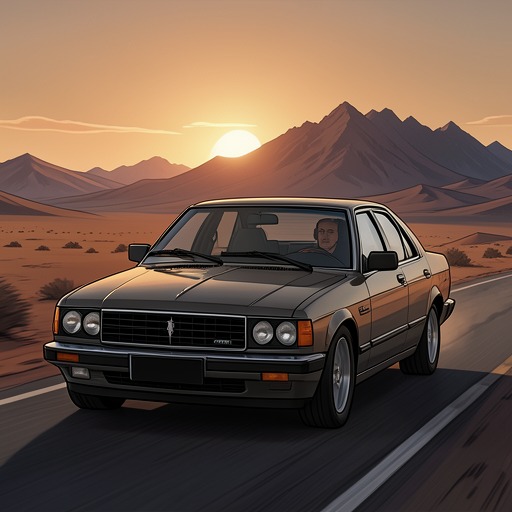
On the RoadMexico City is the far-off destination that gives the southbound journey its measure and imagined horizon. From the border at Laredo, the travelers read the road as pointing toward one great city, still 767 miles away; the distance turns Mexico from a border crossing into a vast passage whose end is at once geographical and visionary.
The Destination on the Map
Before the crossing, the planned journey already has Mexico City as its culminating point. The travelers calculate a route of more than a thousand miles, mostly through Texas to Laredo, followed by another 767 miles across Mexico. The figures make the undertaking concrete even as the destination seems almost fabulous: the journey is no longer east to west, but south into unfamiliar terrain.
After crossing the Rio Grande, the road’s markers reinforce that orientation. Near Sabinas Hidalgo, Dean Moriarty points out that the mileposts are in kilometers and count down the distance to Mexico City. The narrator describes it as the only city in the whole land to which everything points. That description registers the travelers’ perspective rather than a neutral account of Mexican geography: for them, the metropolis becomes the organizing center of the new road.
A Horizon Beyond the Border
The first hours in Mexico give the destination an expansive imaginative reach. At dawn, the travelers are already far from the lights of the border, moving through desert with the Gulf of Mexico behind them. Dean frames the crossing as entry into an unknown phase, while the narrator imagines the older American outlaws who once crossed the same border toward Monterrey. The two responses place the road within competing layers of memory and expectation: a personal break with the past, and a history of movement across the frontier.
Mexico City also anchors Dean’s vision of further travel. He imagines the road continuing through the continent toward South America, and the narrator pictures the travelers descending the curve of the Western Hemisphere into other climates and worlds. The city is therefore both a specific endpoint announced by the road signs and a threshold in an imagined route that might extend still farther south.
The Journey’s Changing Scale
The approach makes the distance palpable through successive landscapes rather than through arrival in the city. At Sabinas Hidalgo, the travelers pass muddy, uneven streets, adobe fronts, burros, and crowds beginning the day. Beyond it, the road climbs from mesquite desert toward the mountains, crosses a high pass, and opens onto the plateau where Monterrey’s factories send smoke into the sky. Dean presses on instead of stopping, intent on making time for Mexico City; the physical fatigue of the others contrasts with his insistence on the destination ahead.
In the evidence of the journey, Mexico City remains a promised point of arrival, not a described scene. Its narrative force comes from that distance: kilometers on the roadside signs, hundreds of miles still to go, and the travelers’ conviction that the road has opened onto a larger world. The city gathers those practical measurements and extravagant hopes into a single, forward-facing horizon.